The Definitive Drucker by Elizabeth Haas Edersheim
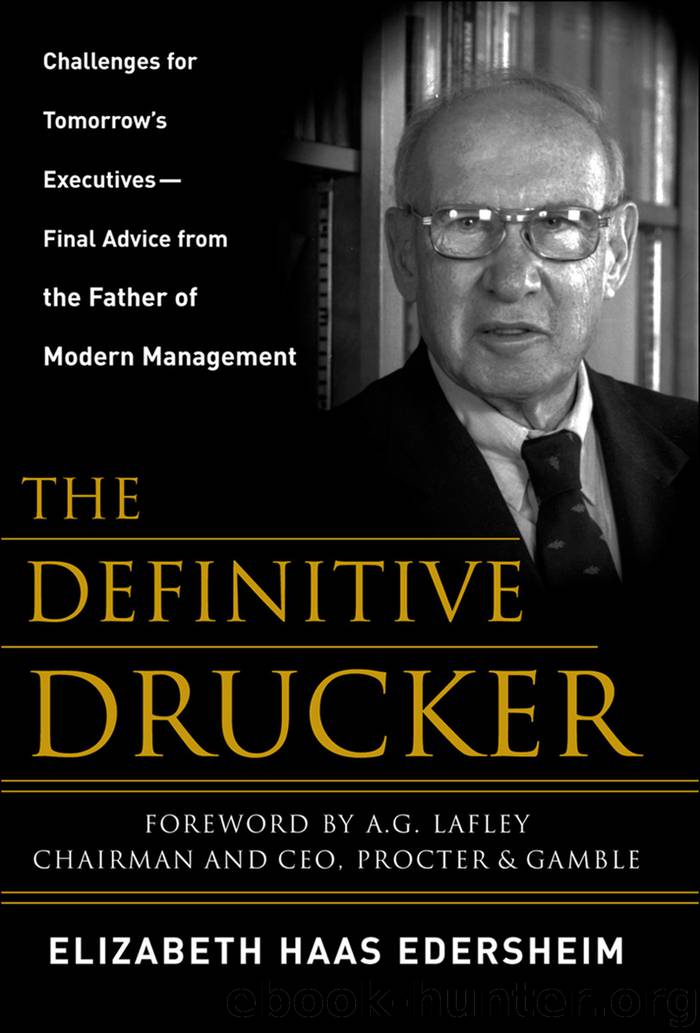
Author:Elizabeth Haas Edersheim
Language: eng
Format: epub
Publisher: McGraw-Hill Education
Published: 2007-03-14T04:00:00+00:00
* * *
The Myelin Repair Foundation defined its front room as orchestrating and coordinating multiple elements of medical research that had never before been operationally linked. The foundation was the connective tissue joining the principal scientific investigators, the experts in the broader scientific and commercial communities, and the pharmaceutical industry. For the foundation, orchestrating meant seeking funding, helping plan the research, operationally linking the labs, providing resources, anticipating needs, and providing a healthy environment for a new, collaborative approach to research.
Research is the heart of the foundation and its reason for being; it is also its backroom. Johnson and Bromley worked together to assemble the best research team possible for this start-up venture. They asked neurobiology experts whom they considered to be the five best scientists in the field with firsthand experience in myelin research, and the same five names popped up every time: Ben Barres of Stanford, David Colman of McGill, Robert Miller of Case Western, Stephen Miller of Northwestern, and Brian Popko of the University of Chicago.
They approached each of these scientists with their unusual request: We would like you (and your university labs) to work collaboratively with us, rather than in the customary isolation; to work under firm and aggressive deadlines rather than in the customary open-ended world of grants; to work toward a goal of developing treatments for patients (who would be the customer) rather than publishing papers for your own academic advancement; to be part of a collective decision-making process with less individual freedom; and, ultimately, to work in concert with business for the eventual marketing of the drug. They became the foundation’s principal investigators despite its highly unconventional operational model.
In retrospect, Johnson understood just how lucky he and Bromley were, and how demographics had helped their quest. Luckily, all of the five scientists were in their late 40s or early 50s, and felt that they didn’t have anything to prove. Each had already been established as a success in the academic process. Each felt that this new model might provide a different kind of return or fulfillment—the possibility of more rapid progress, the opportunity to collaborate rather than compete with brilliant peers, the prospect of demonstrating an entirely new model of research with the potential to broadly transform critical research, and the rewards of being associated with actual treatment.
In the world of high technology, the classic example of collaboration is Linux, the open-source operating system. It has revolutionized the way software is made and has emerged as a powerful model of successful decentralized collaboration. Linus Torvalds wrote the beginning, or, as he called it, the “kernel,” of an operating system in 1991. He made it available to everyone and invited others to improve on it. His front room is the original kernel and the decision authority built into the software to accept changes. The backroom is executing all the changes.
The Linux operating system that resulted from this collaboration includes code written by thousands of volunteer programmers all over the world, united in their desire to make Linux a constantly improving product and an unstoppable force in computing.
Download
This site does not store any files on its server. We only index and link to content provided by other sites. Please contact the content providers to delete copyright contents if any and email us, we'll remove relevant links or contents immediately.
Hit Refresh by Satya Nadella(9099)
The Compound Effect by Darren Hardy(8901)
Change Your Questions, Change Your Life by Marilee Adams(7713)
Nudge - Improving Decisions about Health, Wealth, and Happiness by Thaler Sunstein(7676)
The Black Swan by Nassim Nicholas Taleb(7082)
Deep Work by Cal Newport(7027)
Rich Dad Poor Dad by Robert T. Kiyosaki(6559)
Daring Greatly by Brene Brown(6485)
Principles: Life and Work by Ray Dalio(6356)
Playing to Win_ How Strategy Really Works by A.G. Lafley & Roger L. Martin(6159)
Man-made Catastrophes and Risk Information Concealment by Dmitry Chernov & Didier Sornette(5974)
Digital Minimalism by Cal Newport;(5731)
Big Magic: Creative Living Beyond Fear by Elizabeth Gilbert(5717)
The Myth of the Strong Leader by Archie Brown(5479)
The Slight Edge by Jeff Olson(5391)
Discipline Equals Freedom by Jocko Willink(5349)
The Motivation Myth by Jeff Haden(5187)
The Laws of Human Nature by Robert Greene(5124)
Stone's Rules by Roger Stone(5062)
